Home › Asphalt Resurfacing & Overlays
Extend the life of your driveway with professional asphalt resurfacing in Phoenix, AZ. We install smooth, durable overlays over sound bases to cover ruts, minor cracks, and weathered surfaces. Our team evaluates your existing pavement and recommends the right overlay solution for long term performance.
Precision Asphalt Phoenix provides professional asphalt resurfacing throughout Phoenix, AZ, Arizona and the surrounding area. Our licensed, insured crew delivers safe, clean, on-time work with a free estimate before anything begins. Call (602) 603-4424 or request your free quote.
Asphalt Resurfacing & Overlays in Phoenix, AZ
Asphalt resurfacing is often the most cost effective way to bring a worn parking lot, roadway, or private drive back to life without paying for a full tear out and replacement. At Precision Asphalt Phoenix, we specialize in resurfacing and overlays that are engineered for the heat, monsoon storms, and soil conditions specific to the Phoenix valley.
Instead of guessing whether your pavement is a good candidate for asphalt resurfacing, we core test and probe the existing base and lower asphalt layers. If the structure underneath is sound, a new overlay can add 8 to 15 years of service life at a fraction of full replacement cost. When we recommend resurfacing, it is because the numbers and the conditions on your property support that choice, not because it is the easiest job for us.
We work on commercial parking lots, HOA streets, shopping centers, medical complexes, industrial yards, and long private drives across Phoenix, from central Phoenix infill properties to newer developments in the West and East Valley. Every resurfacing plan is built around how that surface is actually used, including traffic loads, turning patterns, and drainage conditions during heavy summer rains.
How We Evaluate if Asphalt Resurfacing Is Right for You
Not every cracked or faded surface is a candidate for an overlay. A careful evaluation up front protects your budget and prevents premature failure. Precision Asphalt Phoenix follows a set procedure on every resurfacing inquiry.
First, we walk the site with you and map out distress types. Long, straight cracks often indicate normal age related shrinkage, while widespread alligator cracking and pumping (oily spots that move under load) usually signal base failure. We document rutting in drive lanes, standing water after irrigation or storms, and any heaving from tree roots.
Second, we test the thickness and strength of your existing asphalt. For most commercial lots in Phoenix, we want to see at least 2.5 to 3 inches of reasonably sound asphalt over a compacted base. For heavier truck traffic, we may recommend additional structural reinforcement or limited removal and replacement in drive lanes, then resurfacing across the rest.
Third, we check the base and subgrade. The Valley has expansive soils in some areas and imported base in others. We probe and, where needed, perform small test pits to see if the base is dry, compact, and stable. If the base is failing, we will recommend localized dig outs and repair before any overlay is placed.
Only when these checks pass do we suggest asphalt resurfacing. If not, we clearly explain why, and provide alternatives so you can make an informed choice.
Step by Step: Our Asphalt Resurfacing & Overlay Process
A successful overlay depends on the preparation you cannot see once the new surface is installed. Precision Asphalt Phoenix uses a detailed, field tested process that is tuned for Phoenix traffic and climate conditions.
1. Site planning and phasing: We plan work in phases so your business, school, or community can keep operating. This includes traffic control plans, temporary access routes, and clear schedules for tenants and customers.
2. Cleaning and surface prep: We power sweep and, if needed, pressure wash to remove sand, dust, and loose material. In Phoenix, windblown dust and tracked soil are constant issues, so we take extra care here. Oil saturated areas are treated with an oil spot primer so the new asphalt can bond.
3. Structural patching and leveling: We sawcut and remove failed sections, rebuild the base if needed, and install full depth asphalt patches. Depressions that hold water are filled with leveling course so the finished surface drains correctly during monsoon storms.
4. Crack repair: Larger cracks are cleaned and filled with hot applied crack sealant. This keeps water from working through the new overlay and weakening the base.
5. Tack coat application: We spray a uniform tack coat, usually an asphalt emulsion, on the existing pavement. This adhesive layer is what bonds the overlay to the old surface. Coverage rate is adjusted for Phoenix heat and surface texture so it does not break too fast in hot weather.
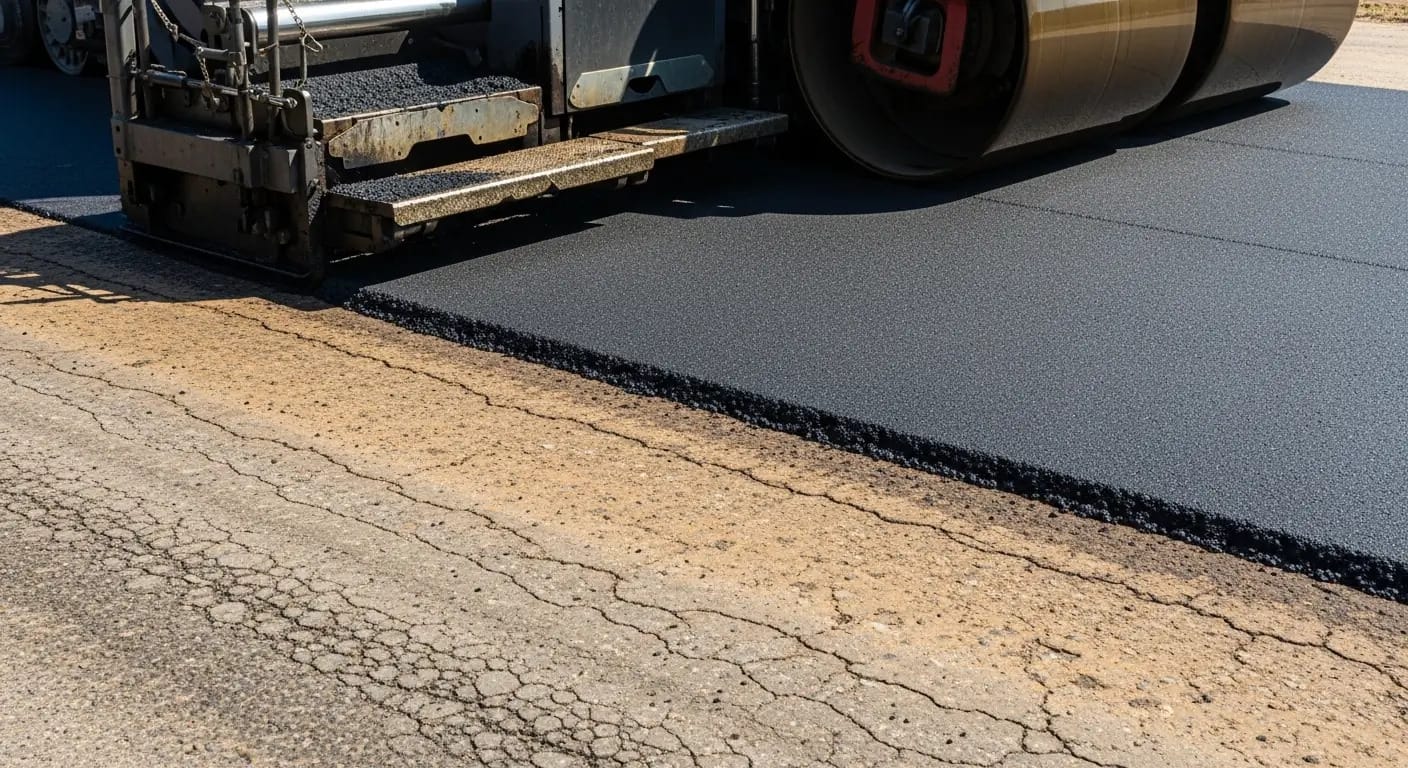
6. Overlay placement: New hot mix asphalt is delivered from local plants that understand our performance requirements. For most commercial overlays in Phoenix, we use a 1.5 to 2 inch surface course. The mix design can be adjusted for truck traffic, slopes, and appearance.
7. Compaction: Rollers compact the new asphalt to target densities. In summer, we schedule paving to avoid peak heat when mix can cool too slowly and become tender. In winter mornings, we account for cooler ground temperatures to achieve proper compaction before the mat cools.
8. Final details: Joints are sealed, lips at concrete transitions are minimized or feathered, and utility lids are raised as needed. Once the surface has cooled, we restripe and install any required pavement markings.
Material Options Built for Phoenix Heat and Traffic
Not all asphalt is the same. The mix chosen for an overlay has a direct impact on how long your resurfaced lot or roadway will last in Phoenix conditions. Precision Asphalt Phoenix works with local suppliers to specify mixes that match your use and budget.
For retail and office parking lots with mostly passenger vehicles, we usually recommend a dense graded surface mix that balances smoothness, appearance, and durability. In areas with sharp turning movements, like drive through lanes or tight loading areas, we may use a mix with more angular aggregate and slightly higher binder to resist shoving and scuffing in high heat.
For industrial properties and sites with regular delivery truck traffic, we often specify a heavier duty surface with larger aggregate and, in some cases, a thicker overlay section. This reduces rutting under slow moving heavy wheel loads, which is common near dumpsters and dock approaches in Phoenix.
We also look at color and texture. Dark surfaces absorb more heat, but they also help with snow and ice in colder climates, which is not a concern here. In Phoenix, managing heat reflection near buildings and pedestrian areas can matter more, so we may recommend different sealcoat schedules or shading strategies after resurfacing.
If your property has unique requirements, such as forklift traffic, regular fuel spills, or high security lighting with strict reflectivity needs, we will recommend specific mix designs and protection strategies instead of generic one size fits all asphalt.
What Drives Asphalt Resurfacing Cost in Phoenix
Property owners often want to know why one resurfacing quote is lower or higher than another. The true cost of asphalt resurfacing in Phoenix depends on several specific factors that Precision Asphalt Phoenix details clearly in our proposals.
Surface preparation scope: Extensive patching, base repairs, or milling to correct drainage will add cost, but skipping these steps usually shortens the life of the overlay. We separate these items on your proposal so you can see what is essential and what is optional.
Overlay thickness: A 1 inch skin patch is cheaper up front but often fails quickly in the Phoenix sun and under heavy use. We typically recommend at least 1.5 inches for light duty and thicker for heavier traffic. More thickness means more material and more trucking, which are major cost drivers.
Access and phasing: Tight sites, night work, or complex phasing to keep businesses open can increase labor and traffic control costs. We design phasing that protects your operations, then show how that affects price.
Striping and compliance: If your lot needs new ADA compliant layouts, fire lanes, or signage updates, we include that in the scope. Phoenix and surrounding municipalities can have specific fire lane and access requirements that must be met as part of an upgrade.
Season and scheduling: In peak paving season, plant and trucking availability can influence pricing. We maintain relationships with multiple Phoenix area plants to control this as much as possible and will sometimes recommend scheduling work at shoulder season times to get better value without sacrificing quality.
Common Phoenix Pavement Problems and How Overlays Fix Them
Phoenix pavement faces a combination of intense UV exposure, high surface temperatures, and sudden heavy rains that can exploit any weakness. Precision Asphalt Phoenix focuses on resurfacing solutions that specifically address these local stressors.
Oxidation and raveling: Over time, the binder in asphalt dries and the surface stones loosen. A resurfacing overlay restores a dense, tight surface and protects the underlying structure from further UV damage.
Minor rutting and depressions: Traffic and subgrade settlement can create wheel path ruts that hold water during storms. Before an overlay, we level these areas and adjust slopes so water sheds properly, reducing the risk of new potholes forming.
Old, failing patches: Many Phoenix lots have years of mismatched cold patches or small concrete infills. During preparation, we remove the worst of these and replace them with full depth asphalt patches so the overlay rests on a more uniform, stable base.
Drainage problems: Standing water is one of the fastest ways to shorten pavement life. Where practical, we correct low areas with milling and leveling course before installing the overlay. If inlet or valley gutter issues are the cause, we coordinate with concrete crews to address those as part of a complete solution.
Edge failures: On driveways and private roads without proper edge support, the asphalt can crack and break away at the sides. We may recommend limited widening, edge strengthening, or adding shoulder material along with the overlay to keep new edges from failing.
What to Expect When You Hire Precision Asphalt Phoenix
Clear communication and realistic expectations are as important as the asphalt itself. When you choose Precision Asphalt Phoenix for asphalt resurfacing or overlays, we guide you through each phase so you know what will happen and when.
Before work starts, you receive a written scope that shows repair areas, overlay thicknesses, and phases. We coordinate with property managers, facility teams, or HOA boards and provide notices you can share with tenants or residents about access changes and curing times.
During construction, our field supervisor is on site to manage traffic control, answer questions, and verify that the work matches the plan. If we discover hidden conditions, such as soft base under a section that looked sound on the surface, we document it and discuss options before proceeding.
After paving, we provide guidance on when to reopen to traffic. Light vehicle traffic is usually allowed within 24 hours, but we may recommend longer cure times in shaded or high stress areas. We also advise you on when to schedule initial sealcoating, which in Phoenix is typically after a suitable curing period, and we give you a simple maintenance schedule to maximize the life of your new overlay.
Our goal is that ten years from now, your resurfaced pavement is still performing the way it should. That is why we put so much emphasis on evaluation, preparation, and honest recommendations from the start.